When linear algebra moves…
36 figures you can manipulate to watch the ideas of linear algebra at work, from systems of equations to the singular value decomposition. They open in the browser, with nothing to install.
These demonstrations stand alone: each one opens and works by itself. For a structured path, The Kinetic Kernel is a separate project, with its own content and interactions.
Non-commercial use only. For commercial use, get in touch.
Designed and built by Andréa Gourion
How to use
- Click or drag
- move a vector or a point; in a 3D view, dragging elsewhere rotates the view
- ‹ › or ← →
- previous or next step or example (a presentation remote works too)
- Space
- main action of the animation (play, project, fit…)
- R
- back to start
- F
- full screen
- S
- save the figure (SVG)
- ?
- help for the animation: what to watch and its shortcuts
On a phone, turn the device sideways for a larger figure.
Start here
Six animations that show what the collection does.
1Linear systems and independence
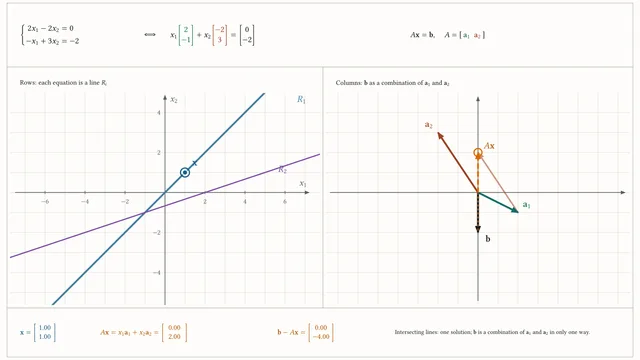 1.1 · Rows and columns
A system seen two ways: the intersection of two lines, and as a combination of and .
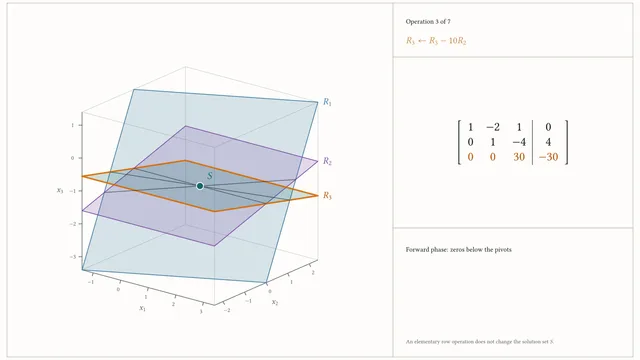 1.2 · Gaussian elimination in 3D
Each equation is a plane; an elementary row operation swings a plane without changing the solution set . 3D
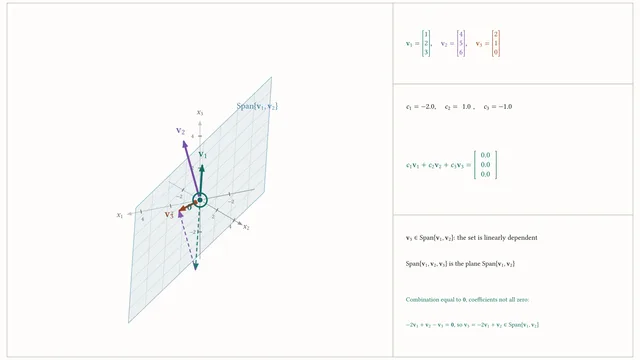 1.3 · Span and independence
Combine , , : a nontrivial combination equal to reveals a linearly dependent set. 3D
2Matrix operations and inverses
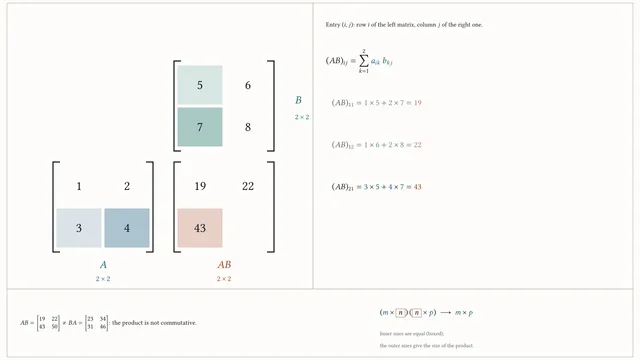 2.1 · Matrix product
Three views of : entry by entry, column by column, row by row; sizes .
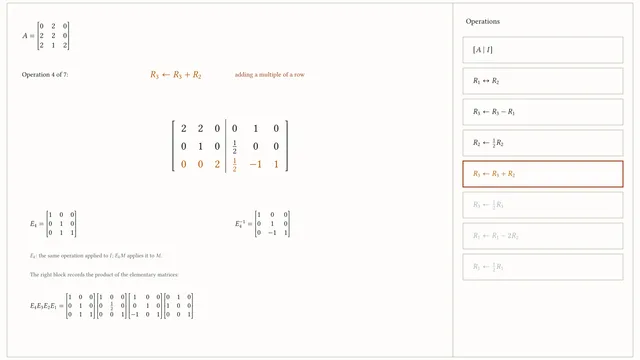 2.2 · Gauss-Jordan
Reduce to : each operation is an elementary matrix , and the right block accumulates them.
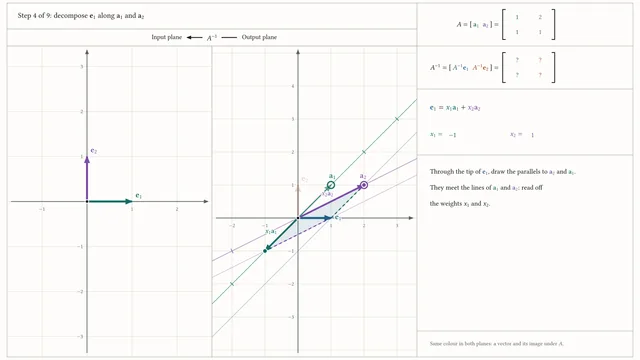 2.3 · Building the inverse of a matrix
Geometric construction of : parallels decompose and along and ; the weights give the columns.
3Block matrices, LU factorization and determinants
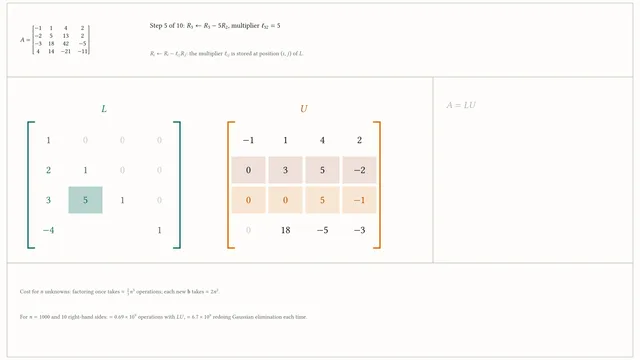 3.1 · LU factorization
Gaussian elimination stores its multipliers in while takes shape; then solve and .
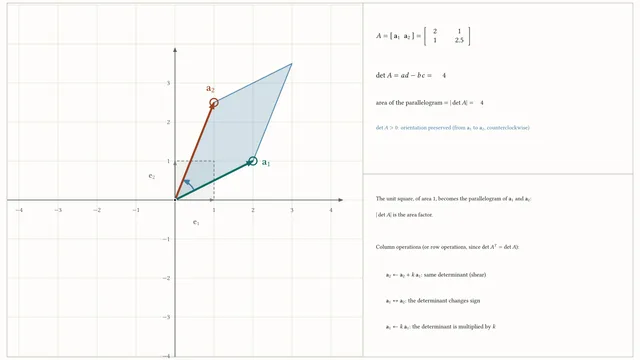 3.2 · Determinant and area
is the signed area of the parallelogram spanned by the columns: shear, swap, scale, flatten.
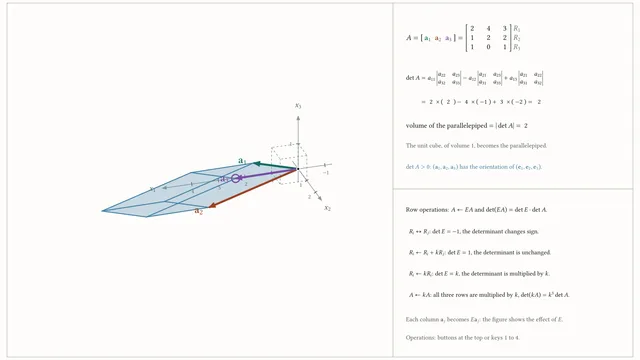 3.3 · Determinant and volume
is the volume of the parallelepiped spanned by the columns; the effect of row operations, and . 3D
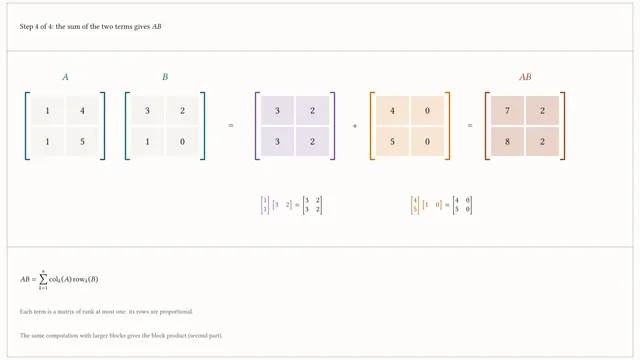 3.4 · Columns rows and blocks
as a sum of column row products, then the block product for a partition of and chosen with the mouse.
4Vector spaces, bases, rank and change of basis
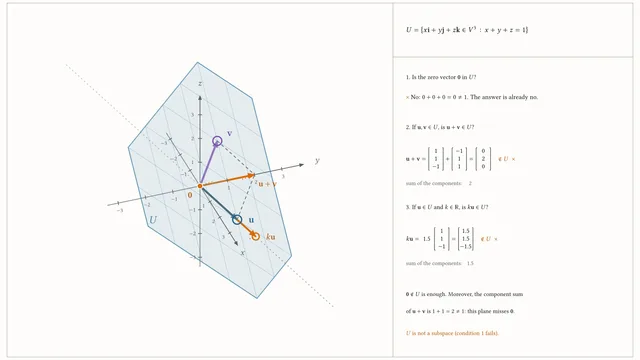 4.1 · Subspace or not?
Test , and on lines and planes, then on spaces of functions and sequences. 3D
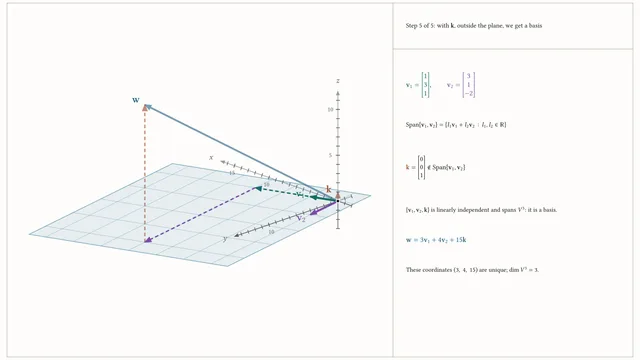 4.2 · Span and basis
lies in the plane , does not; a vector outside the plane extends the set to a basis of . 3D
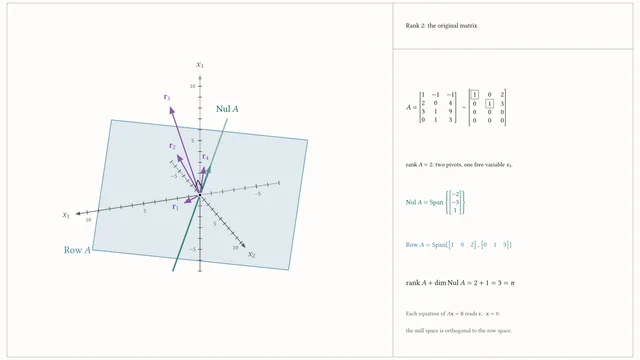 4.3 · Rank and null space
A matrix: pivots, and in ; the rank goes from 3 down to 0. 3D
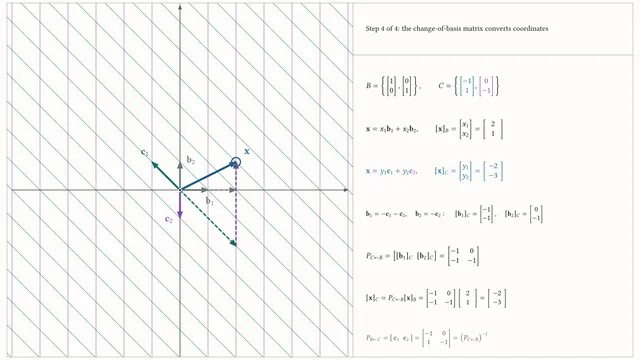 4.4 · Change of basis
The same vector in two bases: the grid of , the coordinates and the change-of-basis matrix .
5Linear transformations
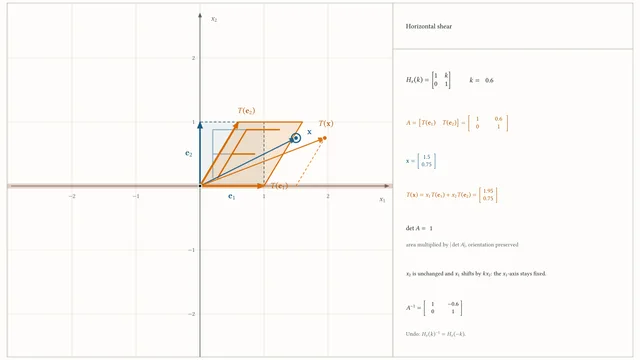 5.1 · Plane transformations
Reflections, , , projections and rotations: the columns of are and ; undo with .
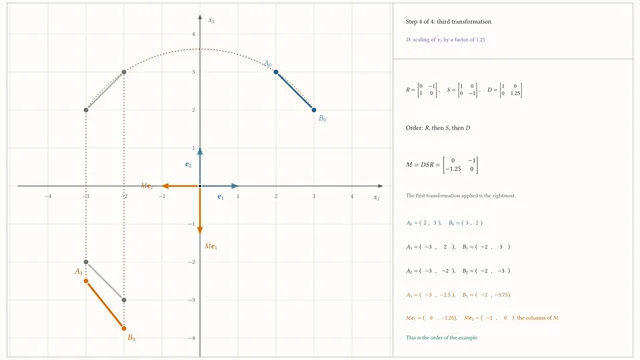 5.2 · Composition: order matters
Rotation, reflection and scaling applied to , and the segment from to : six orders, four results.
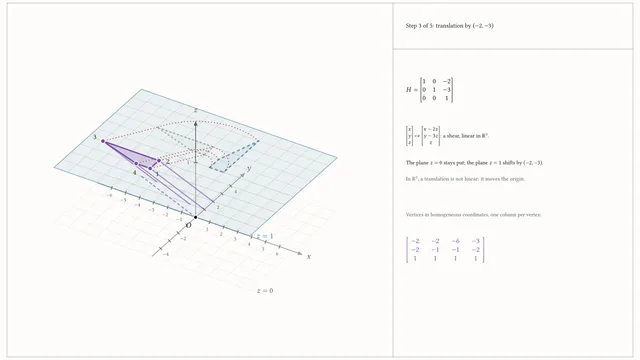 5.3 · Homogeneous coordinates
A trapezoid: rotation, translation and reflection as matrices; the translation becomes a shear of . 3D
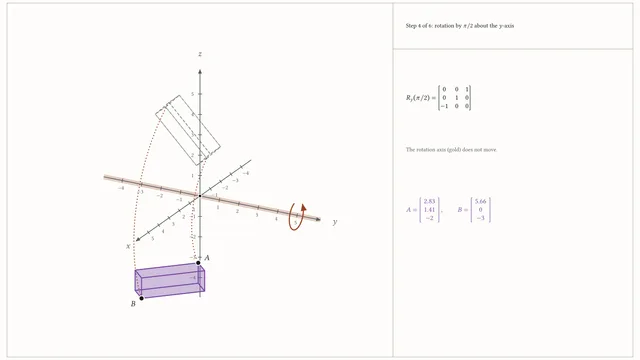 5.4 · Rotations in space
sends to ; then a parallelepiped rotates about , and . 3D
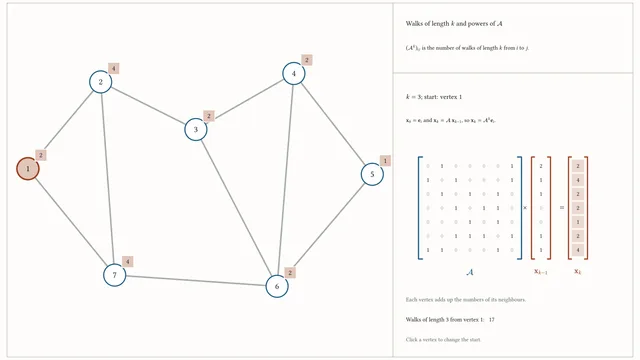 5.5 · Graphs and matrices
Adjacency matrix of a graph, walks of length counted by , incidence matrix of a directed graph, node balances .
6Complex numbers
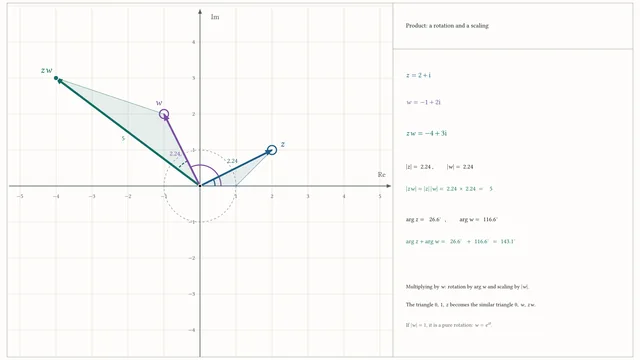 6.1 · The complex plane
and its conjugate; sums as vectors; products that rotate and scale; powers in a spiral (De Moivre).
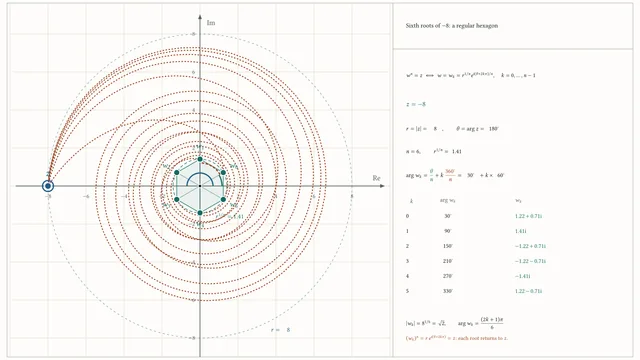 6.2 · th roots
The sixth roots of form a hexagon of radius ; raised to the power 6, they all return to .
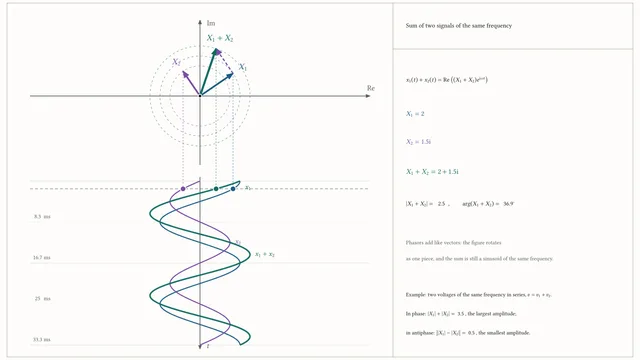 6.3 · Phasors
for a spring and for a circuit: sum of two phasors, then Ohm’s law in complex form, .
7Eigenvalues, eigenvectors and diagonalization
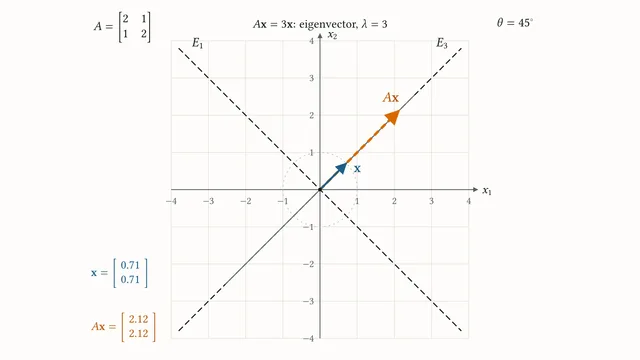 7.1 · Eigendirections
Rotate around the origin and find the directions in which stays aligned with .
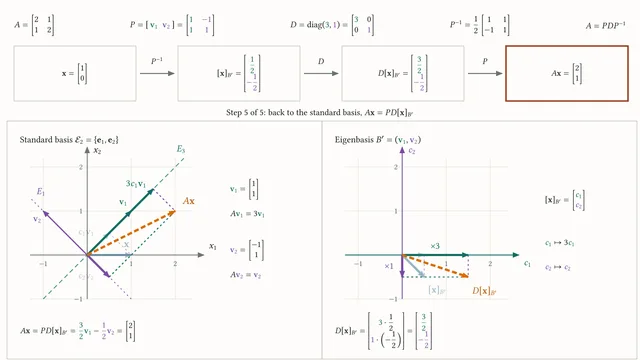 7.2 · : through the eigenbasis
Follow through , , then : in the eigenbasis, acts coordinate by coordinate.
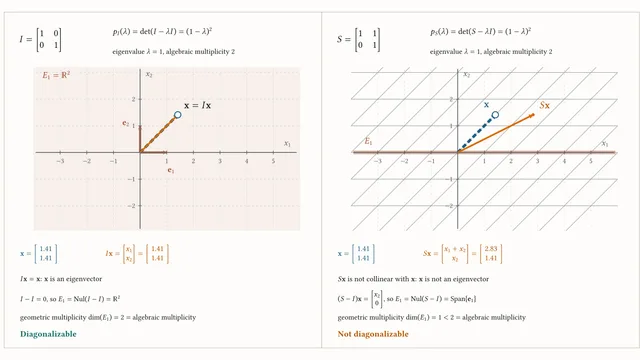 7.3 · Identity and shear
Same characteristic polynomial, but only one eigenline for the shear: it is not diagonalizable.
8Orthogonality, the Gram-Schmidt process and least squares
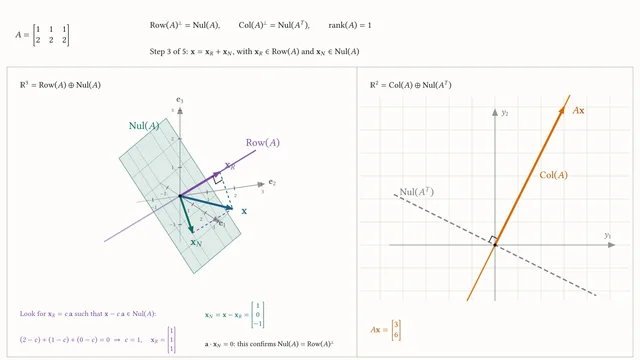 8.1 · Four subspaces
Split into a part in the row space and a part in the null space, then compare their images under . 3D
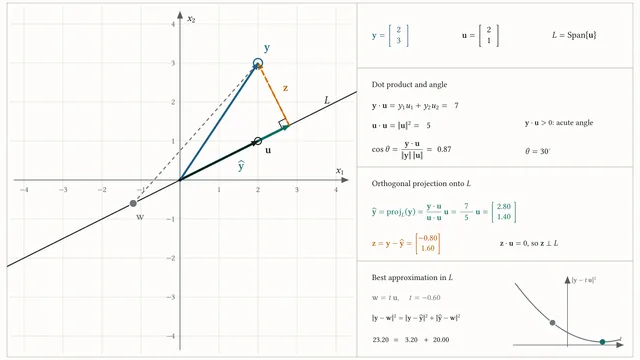 8.2 · Projection onto a line
Drag and : the projection and the residual , orthogonal to , update as you go.
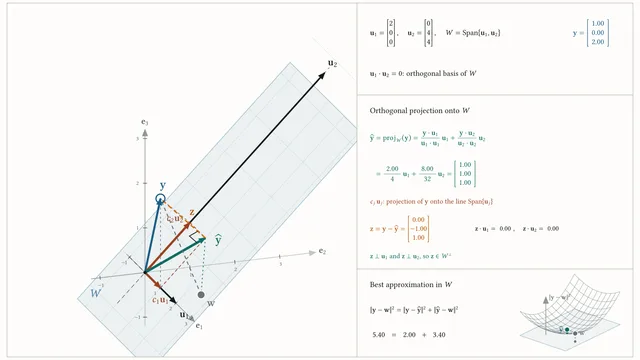 8.3 · Projection onto a plane
Add the projections onto two lines: this gives the projection onto only if the basis is orthogonal. 3D
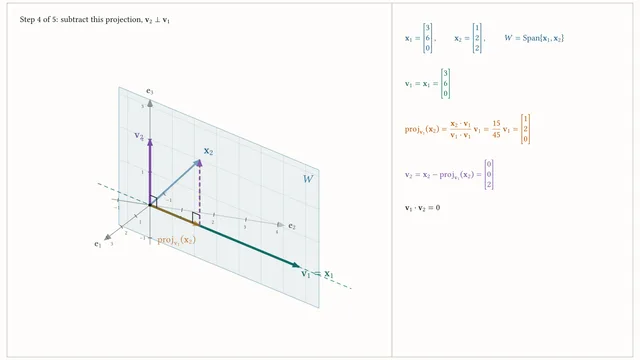 8.4 · Gram-Schmidt
Build, step by step, an orthonormal basis of the plane spanned by and . 3D
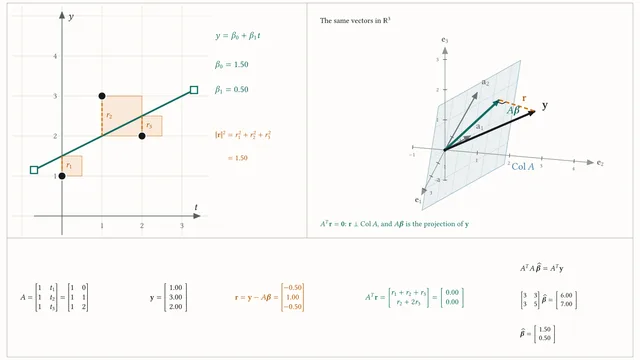 8.5 · Least squares
Drag the measurements or the line, then fit: the best line solves the normal equations . 3D
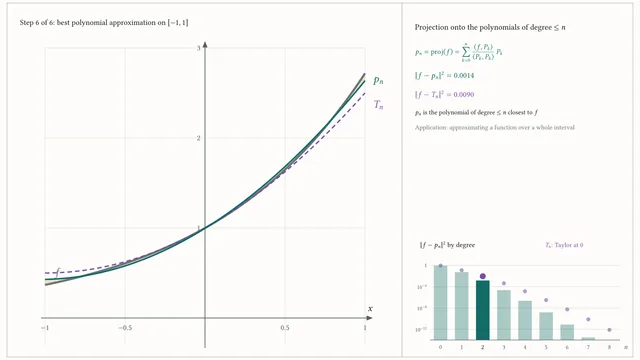 8.6 · Legendre polynomials
Gram-Schmidt on with an inner product of functions, then the best approximation.
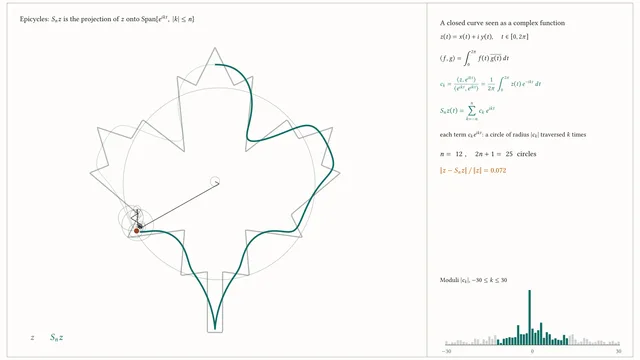 8.7 · Fourier and epicycles
Project a signal onto sinusoids, then redraw a curve with rotating circles.
9Symmetric matrices, quadratic forms and the singular value decomposition
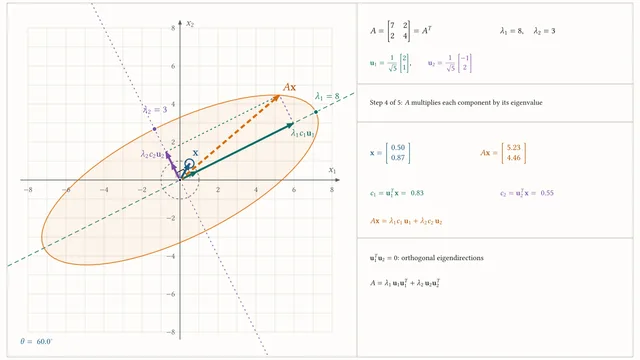 9.1 · Symmetric matrix
The unit circle becomes an ellipse whose axes are the eigendirections, which are orthogonal: .
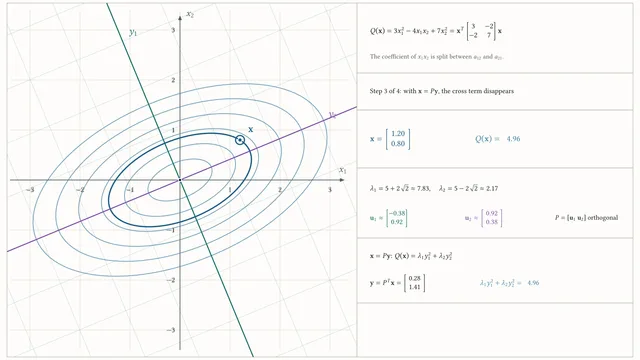 9.2 · Quadratic forms
Level curves, principal axes and the surface : the signs of the eigenvalues classify the form. 3D
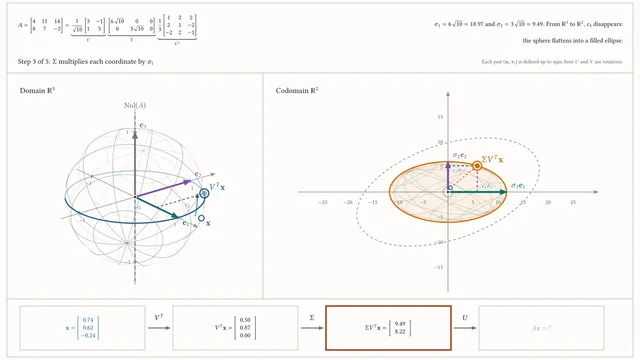 9.3 · Geometry of the SVD
sends the to the axes, stretches or flattens, sends the to the . All sizes, ranks 1 to 3. 3D
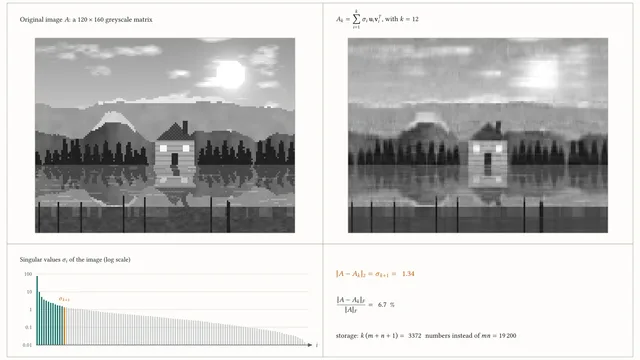 9.4 · Rank approximation
Keep the first terms of the SVD: error , image compression.
Going further
For structured learning, explore The Kinetic Kernel. For a demonstration made for your own context, get in touch.